




위 식에서 triplet loss 의 흔적을 찾는다고 생각해 보자. z_i 는 achor 을, z_j 는 positive sample 을 대변하는 친구, z_k 는 negative sample 을 대변하는 친구이다. negative sample 과 anchor 내적값의 차를 통해 loss 를 계산한다. 이때 여기서 N 이 아니고 2N 인 이유는, N 의 단위는 pair 이기 때문이다. (참고 :  Encoder 및 projection head는 batch 단위로 학습하게 되는데, 만약 N의 batch size를 이용하게 된다면 각각 data augmentation을 거쳐서 2N개의 sample을 얻을 수 있습니다. 이렇게 되면 각 sample 별로 1쌍의 positive pair와 2N-2쌍의 negative pair를 구성할 수 있게 됩니다. 논문에서는 positive pair 간의 similarity는 높이고, negative pair 간의 similarity는 최소화하는 형태의 loss function을 제안하여 학습에 활용하였습니다. (질문 넣음. 2N-2쌍이 아니라 N-1 쌍 아니냐고 → 안녕하세요. 1개의 query sample에 대해, positive pair를 이루는 1개의 sample을 제외한 나머지 2n-2 개의 sample들과 각각 negative pair를 구성할 수 있습니다. n개의 이미지 중 query sample이 되는 1개의 이미지를 제외한 n-1 개의 다른 이미지들이 augmentation을 거쳐서 2n-2개의 sample이 되고, 이것들과 모두 negative pair를 이룬다고 이해하시면 될 것 같습니다.)) a 개의 데이터를 2번씩 augmentation 시키면, 2a 개의 데이터가 나오는데, 각 영상(anchor)의 입장 에서는 1개의 positive sample (1 개의 positive pair), 2a-2 개의 negative sample 인데 그 "각각"에 대해서 negative pair 로 쓸 수 있으므로 2a 개의 pair 라는 것이다. positive-negative 가 10쌍이면 데이터의 수는 20개가 된다. 하나의 anchor 에 대해서 나머지 18 개로 negative pair 을 만들 수 있으니 얼마나 좋은가.
triplet loss 와 다르게, loss 를 구하는 데 z_k 를 지정해 줄 필요가 없는데, 어떤 z_i, z_j 가 input 으로 사용되든 모든 neagtive z_k 에 대해서 전부 연산을 거치기 때문이다.
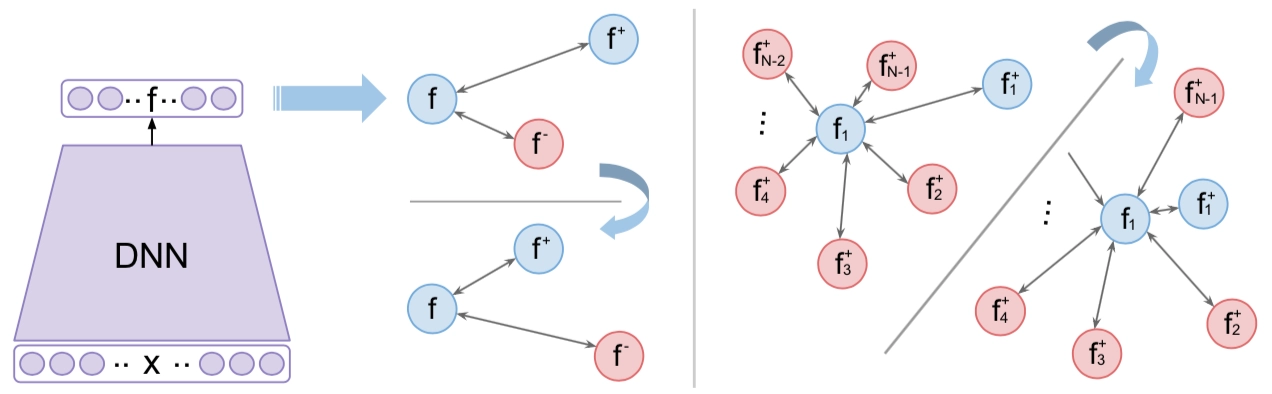
Triplet loss (left) and its extension (N+1)-triplet loss (right) (from Sohn 2016)
이해하고 보면 이것은 굉장히 잘 그려진 그림이라는 것을 알 수 있다. 어떤 input x 를 3개 넣었다고 생각해 보자. 곡선 화살표는 모델의 optimization 이전과 이후의 변화를 나타낸다. 이 그림이 보여주고 싶은 것은, 그냥 위 식은 triplet loss 의 일반화라는 점이다.
Default view
Search

위 식을 조금 더 잘 정리하면 아래와 같은 형태가 나온다.
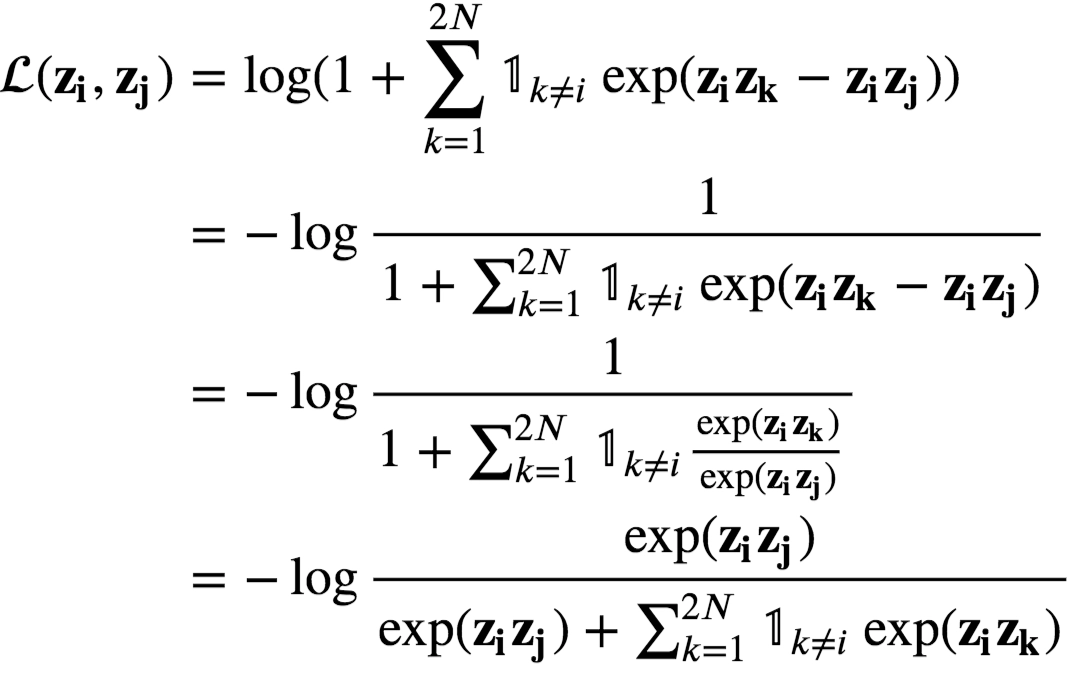

z_i 는 반드시 anchor 이고 여기서 z_j 는 반드시 positive sample 이다. (NX-Xent loss 참고 Supervised NT-Xent loss (Khosla et al. 2020), let's first look at the self-supervised version of NT-Xent loss. NT-Xent is coined by Chen et al. 2020 in the SimCLR paper and is short for "normalized temperature scaled cross entropy loss‣”. It is a modification of the multi-class N-pair loss with addition of the temperature parameter (𝜏) to scale the cosine similarities. Chen et al. found that an appropriate temperature parameter can help the model learn from hard negatives. 도 마찬가지이다.)
언뜻 z_j 에 해당하는 것에 negative sample 를 넣어 더 일반화시켜도 되지 않을까? 하는 생각이 들 수 있지만,
잘 생각해보면 z_j 에 posive 가 들어가든 negative 가 들어가든 -log(a/b) 에서 분모 b 는 대체적으로 똑같을테고 분자인 a 만 변하는데, a/b=1 이어야 loss=0 이므로 Optimal 이다. 이 상태로 훈련을 시키는 것이다.
당초 취지가
 positive / (positive_all +
 negative_all) 가 1 에 가까워지록 교육
*방향 과 은 해당 요소가 어떻게 변화했으면 좋겠다는 우리의 바람이다.
인데 만약 negative 과 anchor 의 유사도가 분자에 들어간다면 아래와 같은 교육을 하게 된다.
negative / (positive_all + negative_all) 가 1 에 가까워지도록 교육
negative 은 증가해야 하는데 negative_all 은 감소해야 한다고? negative 은 negative_all 의 부분집합이다. 게다가 positive_all 은 증가하기를 바라야하는데 이 식에서는 감소하기를 바라므로 이건 노이즈이다.
 loss 를 해석할 때 이렇게 (참고3) 식의 요소를 각각, 귀납적으로(?) 해석해도 되는건가? 논문 (supervised contrastive loss ‣) 에서 이걸 역전파식으로 유도 (참고1) 하는 것이 나오던데, 이런 직관과 현실이 조금 다른 경우들이 왕왕 존재하는 것 같다. 해당 논문 (참고2) 을 참고해서 개념을 확실히 하는건 어떨까? 관련 의문 (참고4)
positive / (positive_all + negative_all) 가 1 에 가까워지록 교육
*방향 과 은 해당 요소가 어떻게 변화했으면 좋겠다는 우리의 바람이다.
인데 만약 negative 과 anchor 의 유사도가 분자에 들어간다면 아래와 같은 교육을 하게 된다.
negative / (positive_all + negative_all) 가 1 에 가까워지도록 교육
negative 은 증가해야 하는데 negative_all 은 감소해야 한다고? negative 은 negative_all 의 부분집합이다. 게다가 positive_all 은 증가하기를 바라야하는데 이 식에서는 감소하기를 바라므로 이건 노이즈이다.
loss 를 해석할 때 이렇게 (참고3) 식의 요소를 각각, 귀납적으로(?) 해석해도 되는건가? 논문 (supervised contrastive loss ‣) 에서 이걸 역전파식으로 유도 (참고1) 하는 것이 나오던데, 이런 직관과 현실이 조금 다른 경우들이 왕왕 존재하는 것 같다. 해당 논문 (참고2) 을 참고해서 개념을 확실히 하는건 어떨까? 관련 의문 (참고4)This form of multi-class N-pair loss helps us introduce the next (Supervised NT-Xent loss (Khosla et al. 2020), let's first look at the self-supervised version of NT-Xent loss. NT-Xent is coined by Chen et al. 2020 in the SimCLR paper and is short for "normalized temperature scaled cross entropy loss‣”. It is a modification of the multi-class N-pair loss with addition of the temperature parameter (𝜏) to scale the cosine similarities. Chen et al. found that an appropriate temperature parameter can help the model learn from hard negatives.) loss function.
